
A 4-day Morocco desert tour from Fes to Marrakech is a one-way private journey across the Middle Atlas, the Sahara at Merzouga and Erg Chebbi, and the kasbah country of the south, ending in Marrakech. Covering roughly 900 km over four days and three nights, this is one of the most complete ways to see Morocco without doubling back on yourself. You leave from your Fes riad or hotel, and four days later you step out of the vehicle in Marrakech having crossed two mountain ranges, one desert, three valleys and a UNESCO World Heritage kasbah.
Unlike a rushed 3-day Fes to Marrakech desert tour, four days gives you breathing room. You are not racing the clock between Ifrane and Merzouga on day one, and you get a proper morning in the dunes rather than a single sunset and an early departure. This page walks through exactly what a 4-day Fes to Marrakech desert tour looks like day by day, what’s included, where you sleep, and how to decide if this is the right itinerary for your trip, courtesy of Desert Marruecos Tours.
4-Day Fes to Marrakech Desert Tour Itinerary
Day 1: Fes to Merzouga via Ifrane, Azrou, Midelt and the Ziz Valley
Your driver picks you up from your Fes riad, hotel or the airport early in the morning. Because much of the Fes Medina is only accessible on foot, your exact meeting point is usually confirmed the day before at the nearest gate or road your vehicle can reach.
The road climbs out of Fes onto the Saiss plains and into the Middle Atlas Mountains, reaching Ifrane first, a tidy mountain town of pitched roofs and stone chalets that earned its nickname as the “Little Switzerland of Morocco.” From there, the route continues to Azrou, home to one of the region’s best-known cedar forests, where wild Barbary macaques are commonly seen along the roadside among the tall cedar trees.
Lunch is typically taken in Midelt, a practical stop between the mountains and the desert plateau, before the road descends through the Ziz Valley, a dramatic run of red cliffs, old kasbahs and thousands of date palms that signals the desert is close. The route passes Erfoud and Rissani, gateway towns on the edge of the Tafilalt oasis, before arriving in Merzouga by late afternoon.
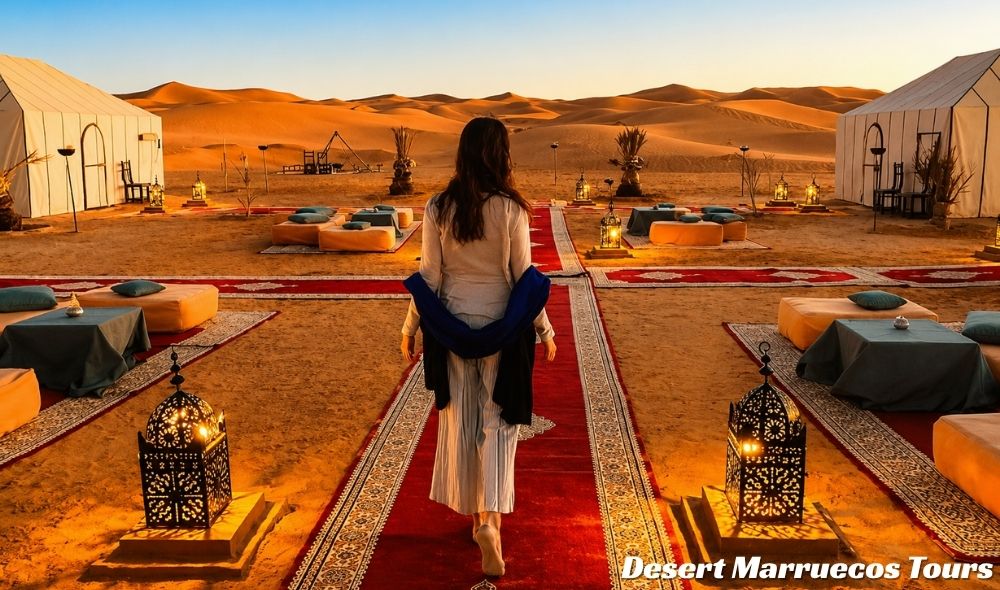
At Merzouga, you transfer to camels for a trek across the Erg Chebbi dunes, timed to catch the desert at sunset as the sand shifts from gold to deep orange. Only a small overnight bag makes the journey by camel; larger luggage travels separately to the camp. A desert camp waits among the dunes for dinner, mint tea and, where available, an evening of Berber drumming around the fire before an overnight stay under a genuinely dark sky, far from any source of light pollution.
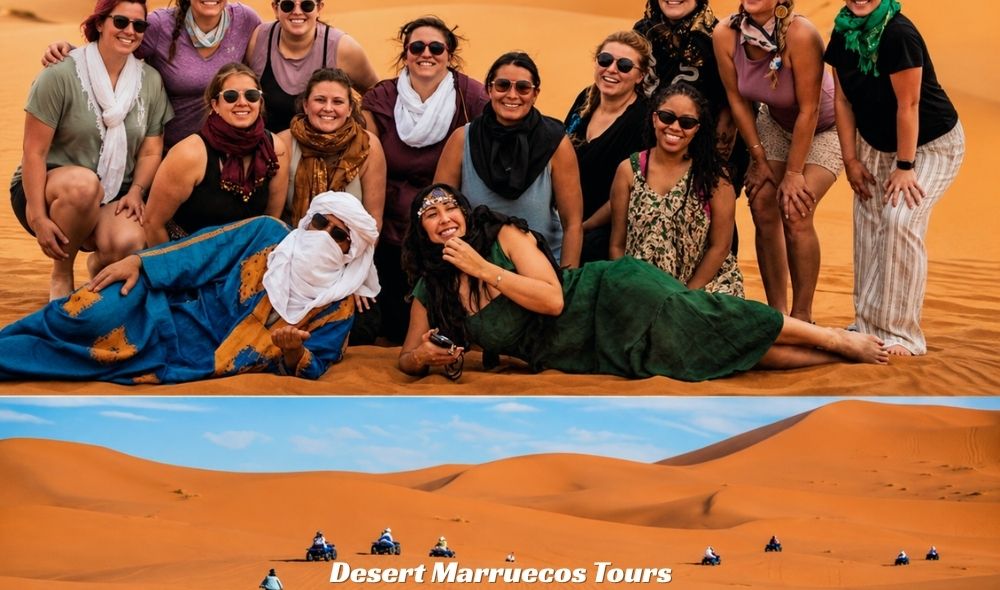
If camel riding isn’t right for everyone in your group, whether due to back problems, young children, or simple preference, a 4×4 excursion across the same stretch of dunes is the standard alternative, and it’s worth flagging this when you book so the camp and driver can plan around it.
Day 2: Explore Merzouga and the Erg Chebbi Dunes
This is where a 4-day Fes to Marrakech desert tour earns its extra day over the 3-day version: instead of packing up and leaving at first light, you get a proper morning in the Sahara. Many travelers wake before dawn to watch the sunrise over Erg Chebbi, when the dunes are at their coolest and the light is at its best for photos.
Depending on your package, the morning can include a short 4×4 desert excursion further into the dunes, a visit to a local nomad family or the nearby village of Khamlia, known for its Gnaoua music traditions, and time to see Dayet Srij, a seasonal lake near Merzouga that occasionally attracts flamingos. After breakfast at the camp, you head back into Merzouga to collect your main luggage and continue the journey south and west.
The afternoon drive moves through Rissani and toward Tinghir, an oasis town at the mouth of Todra Gorge, where you’ll spend the night in a hotel or riad rather than returning to a tent. Tinghir itself is worth a slow look, with palm groves lining the river below, and the shift from bare desert plateau to green oasis is one of the more striking transitions on the whole route.
Day 3: Merzouga to Todra Gorge and Dades Valley
Day 3 trades desert sand for canyon rock and valley scenery. The morning is spent at Todra Gorge, one of Morocco’s most striking natural landmarks, where limestone walls rise steeply on either side of a narrow river passage. A short, flat walk through the gorge is included, with plenty of time for photos before the road continues.
From Todra, the route follows the Dades Valley, sometimes called the Valley of Roses for the rose fields around Kelaat M’Gouna, and continues along the famous Road of a Thousand Kasbahs. Fortified villages, red rock formations and small Berber communities line the road, and the pace here is noticeably slower than Day 1. This is a day for looking out the window as much as it is for driving.
Along the way, keep an eye out for Skoura’s palm groves and old kasbah architecture, part of the wider Road of a Thousand Kasbahs that connects this stretch of southern Morocco. Overnight is usually in the Dades Valley or, depending on timing, closer to Ouarzazate, in a hotel, kasbah guesthouse or riad-style property with private facilities.
Day 4: Ouarzazate, Ait Ben Haddou and Marrakech
The final day begins with a stop in Ouarzazate, often called Morocco’s “Hollywood of Africa” for its film studios and dramatic desert-edge scenery, before continuing to the undisputed highlight of the day: Ait Ben Haddou. This UNESCO World Heritage ksar, a fortified earthen village built along the old caravan route between the Sahara and Marrakech, is one of the most photographed sites in southern Morocco, and there’s time here to walk through the old village and climb to the upper viewpoint.
From Ait Ben Haddou, the road climbs into the High Atlas Mountains and crosses the Tizi n’Tichka pass, at roughly 2,260 meters one of the highest paved mountain passes in North Africa, with sweeping views back over the valleys you’ve just left. Mountain villages and roadside stalls selling local minerals line parts of the descent, and if you’re prone to motion sickness on winding roads, this is the stretch to prepare for in advance.
The descent into Marrakech brings the tour to a close, typically in the late afternoon or early evening depending on stops and traffic, with drop-off at your Marrakech hotel, riad or the nearest point your vehicle can reach if your accommodation sits inside the pedestrian streets of the Medina.
Local Highlights Along the Fes to Marrakech Route
Why Choose Our 4-Day Fes to Marrakech Desert Tour?
Private Tour and Your Own Driver
This is a private Fes to Marrakech desert tour, not a shared bus route with fixed stops chosen by someone else. From the moment your driver-guide collects you at your Fes hotel, riad or the airport, the itinerary bends around your group rather than the other way around. Want an extra half hour at Azrou to watch the Barbary macaques, or a slower walk through Todra Gorge? On a private tour, that’s simply a conversation with your driver, not a request that gets refused because a shared minibus is running to a schedule.
Comfortable Air-Conditioned 4×4 or Minivan
Transport on this route is an air-conditioned 4×4 or minivan, matched to your group size. Smaller groups and couples typically travel in a private 4×4 or SUV, which handles the desert-fringe roads around Merzouga comfortably and gives a slightly higher, better view over the Ziz Valley and Dades Gorge. Families and small groups of four to six are usually better suited to an air-conditioned minivan, which keeps everyone together with more luggage space. Either way, comfort matters on a route with long driving days, so the vehicle should have working air conditioning, seatbelts for every seat, and enough boot space for four days of luggage plus a smaller overnight bag for the desert camp.
Camel Trek and Erg Chebbi Desert Camp Included
The centerpiece of any Fes to Marrakech Sahara tour is the night in the dunes. On this 4-day itinerary, that means a camel trek across Erg Chebbi at sunset, an overnight stay at a desert camp, and the option to catch sunrise over the dunes the next morning before breakfast. If camel riding isn’t comfortable for you or a member of your group, a 4×4 excursion into the dunes is the standard alternative, and it’s worth mentioning this preference when you book.
Flexible Stops and a Personalized Pace
Because the tour is private and one-way, there’s no pressure to reach a fixed hotel by a fixed hour just so a shared vehicle can continue its route the next morning. That flexibility is what allows four days to feel noticeably calmer than three, particularly on the long first stretch between Fes and the desert.
Highlights of the Fes to Marrakech Desert Route
Ifrane and the Middle Atlas Mountains
Ifrane’s alpine architecture and cool mountain air make it a memorable first stop, a genuine contrast to the desert scenery that follows later in the trip.
Azrou Cedar Forest and the Barbary Macaques
The cedar forest at Azrou is one of the best places in Morocco to see wild Barbary macaques in a natural setting, alongside some of the country’s oldest cedar trees.
Ziz Valley and the Desert Gateway Towns
The Ziz Valley marks the transition from mountains to desert, its palm groves and oasis villages giving way to Erfoud and Rissani, the traditional gateway towns to the Sahara.
Merzouga and Erg Chebbi
Merzouga and the Erg Chebbi dunes are the reason most travelers book this route in the first place: tall, photogenic dunes that shift color throughout the day.
Camel Trek, Sunset and the Desert Camp
The camel trek into the dunes at sunset, followed by a night at a desert camp under the stars, remains the single most requested experience on any Morocco Sahara tour.
Todra Gorge and Dades Valley
Todra Gorge’s sheer canyon walls and the Dades Valley’s kasbahs and rock formations provide a complete change of scenery from the desert the day before.
Ait Ben Haddou and Ouarzazate
Ait Ben Haddou’s earthen ramparts and Ouarzazate’s film-industry history round out the cultural highlights of the southern route.
Tizi n’Tichka and the High Atlas
The final mountain crossing at Tizi n’Tichka closes the loop between desert and city, delivering some of the trip’s best panoramic views just before arrival in Marrakech.
What's Included in the 4-Day Fes to Marrakech Desert Tour?
A well-structured 4-day tour typically includes:
- Pickup from your Fes hotel, riad or airport
- Private, air-conditioned 4×4 or minivan transport for the full route
- An experienced local driver-guide
- Fuel and road costs for the entire journey
- One night at a Sahara desert camp near Erg Chebbi
- Two nights in hotels, riads or guesthouses along the southern route
- Camel trek into Erg Chebbi
- Breakfasts throughout, and dinner where specified in your booking
- All planned sightseeing stops along the itinerary
- Drop-off at your Marrakech hotel, riad or nearest accessible point
Typically excluded are lunches, drinks, tips, travel insurance, optional activities such as sandboarding or quad biking, and any entrance fees not specifically listed. Always confirm the final written itinerary before paying, since inclusions can vary slightly between bookings.
What’s Not Included
Being clear about exclusions matters as much as listing inclusions. On this 4-day Fes to Marrakech Sahara tour, you should generally budget separately for:
- Lunches along the route, typically 80 to 150 MAD per person depending on the restaurant
- Bottled water and other drinks beyond what’s served with dinner
- Tips for your driver-guide and camp staff
- Travel insurance
- Optional add-ons such as sandboarding in Erg Chebbi or a fossil workshop in Erfoud
- Entrance fees at sites where a paid local guide is optional rather than compulsory
- Any accommodation upgrade beyond the category confirmed in your booking
A transparent operator will spell all of this out in writing before you pay a deposit, so there are no surprises once you’re on the road.
Who Is This 4-Day Fes to Marrakech Desert Tour For?
Couples
This route is one of the most popular choices for couples touring Morocco, thanks to the combination of a private vehicle, a shared camel trek at sunset, and a night under the stars at the desert camp. A private 4-day Fes Marrakech desert tour for couples also allows for a slower pace at Todra Gorge and Ait Ben Haddou, ideal for photography and simply enjoying the scenery together.
Families
A 4-day Fes Marrakech desert tour for families works well because the extra day, compared with the 3-day version, reduces the pressure of a single very long driving day. Families should confirm car-seat availability if traveling with young children, plan for the camel trek to be optional for younger kids, and consider requesting a 4×4 desert transfer instead of camel riding for anyone nervous around animals.
Solo Travelers and Small Groups
Solo travelers can book this as a private tour or join a small shared group, depending on availability. Either way, the route itself doesn’t change: Ifrane, Azrou, Merzouga, Todra Gorge, Dades Valley, Ait Ben Haddou and Marrakech remain the same core stops.
Senior Travelers
A 4-day Fes Marrakech desert tour for seniors benefits from the private vehicle format, which allows for more frequent rest stops and a gentler overall pace than the 3-day route. Travelers with mobility concerns can also choose the 4×4 desert transfer over the camel trek, and can remain in the lower section of Ait Ben Haddou rather than climbing to the upper viewpoint if the terrain feels uneven.
Where You’ll Stay During the Tour
Desert Camp in Erg Chebbi
Your one night in the Sahara is spent at a desert camp among the Erg Chebbi dunes. Standard camps offer comfortable shared-facility tents with bedding, dinner and breakfast included. Travelers who want more privacy can upgrade to a luxury camp, with a private ensuite tent, better bedding and a more private dining setup. If you’re weighing the cost difference, this breakdown of how much a luxury desert camp in Morocco costs is worth reading before you book.
Hotels and Riads Along the Route
The remaining two nights are spent in hotels, kasbah guesthouses or riad-style properties in the Todra/Dades area and near Ouarzazate. These give you a proper bed, a private bathroom and a chance to recover from the driving before the next day’s stops.
Private 4x4 or Minivan: Which Is Best for Your Group?
Best Time for This Morocco Desert Tour
Spring (March to May) and autumn (September to November) offer the most comfortable conditions for this route, with warm days and cool, manageable desert nights. Summer is possible but the Sahara can be extremely hot during the day, so early starts and hydration matter more. Winter brings cold desert nights and occasional snow on the Tizi n’Tichka pass, so warm layers are essential even if the daytime temperature feels mild. For a full seasonal breakdown, see this guide to the best time to visit Morocco.
What to Pack for the Sahara Desert
- Comfortable walking shoes for Todra Gorge and Ait Ben Haddou
- A warm layer for cold desert nights, even in summer
- Sunglasses, a sun hat and sunscreen
- A small overnight bag for the desert camp, separate from your main luggage
- A power bank, since electricity at the camp can be limited
- A reusable water bottle
- Any personal medication, and motion-sickness tablets if you’re sensitive to mountain roads
Local Highlights Along the Fes to Marrakech Route
Each end of this journey has its own character worth a mention. Fes, the starting point, is one of Morocco’s imperial cities, and many travelers spend a day or two exploring the Fes Medina, its tanneries and its riads before setting off on the desert tour. See the day trips from Fes for ideas if you have extra time before departure. Merzouga, roughly in the middle of the route, is the small desert town that gives access to the Erg Chebbi dunes, and it’s worth noting this is a genuinely different desert experience from routes that head toward Zagora instead. The comparison of Merzouga vs Zagora explains why most first-time visitors choose the Merzouga side. Marrakech, the finishing point, is Morocco’s most visited city, and after four days on the road, most travelers are glad to arrive somewhere with a wide choice of riads, restaurants and a lively Medina to unwind in. The Marrakech day trips page is useful if you’re planning to extend your stay there afterward.
Frequently Asked Questions
Is 4 days enough for a Fes to Marrakech desert tour? Yes. Four days covers the full route, including the Middle Atlas, Merzouga, Erg Chebbi, Todra Gorge, Dades Valley, Ait Ben Haddou and Ouarzazate, with a more comfortable pace than the 3-day version.
How far is Fes from Merzouga? Merzouga is roughly a full day’s drive from Fes, around 8 to 10 hours including stops at Ifrane, Azrou, Midelt and the Ziz Valley.
How far is Merzouga from Marrakech? The remaining stretch from Merzouga to Marrakech, via Todra Gorge, Dades Valley, Ouarzazate and Ait Ben Haddou, is covered over the last two to three days of this itinerary.
Is the tour private? Yes, this is a private, one-way tour with your own driver and vehicle for the entire route.
Is a camel trek included? Yes, a camel trek across Erg Chebbi at sunset is included, with a 4×4 desert excursion available as an alternative.
Is the desert camp private? Standard camps typically have shared facilities, while a luxury camp upgrade provides a private ensuite tent.
Can I customize the itinerary? Yes, since this is a private tour, stops, pace and timing can be adjusted to suit your group.
Can I change the pickup or drop-off location? Yes, pickup and drop-off can be arranged at your Fes and Marrakech hotel, riad or the nearest accessible point.
Is the tour suitable for children or older travelers? Yes, with a 4×4 alternative to the camel trek and a private vehicle that allows for more frequent rest stops.
What should I pack for a Morocco desert tour? Comfortable shoes, a warm layer for the desert nights, sun protection, a small overnight bag for the camp, and a power bank.
How much does a 4-day Fes to Marrakech desert tour cost? Price depends on group size, whether you choose a standard or luxury desert camp, and the hotel category along the route. Request a written quote listing exactly what’s included before booking.
Are breakfast and dinner included? Breakfast is included throughout the tour, and dinner is typically included at the desert camp; check your confirmation for dinner arrangements on the other nights.
Does the tour visit Ifrane and Azrou cedar forest? Yes, both are included on Day 1 as you cross the Middle Atlas Mountains between Fes and Merzouga.
Does the tour include Todra Gorge and Dades Valley? Yes, both are core stops on Day 3 between Merzouga and Ouarzazate.
Where does the tour start and end? The tour starts in Fes, at your hotel, riad or the airport, and ends in Marrakech at your hotel, riad or the nearest accessible point.
Book Your 4-Day Fes to Marrakech Desert Tour
This 4-day route from Fes to Marrakech through the Sahara brings together the Middle Atlas, the dunes of Erg Chebbi, Todra Gorge, Dades Valley and Ait Ben Haddou in a single, well-paced private journey. If you’re still comparing regions, this guide to Merzouga vs Zagora explains why Merzouga is the desert of choice for this particular route. And if you have time before or after your desert tour, consider adding one of the day trips from Fes or exploring more of the Morocco travel blog for route comparisons and packing guides.
To check availability, send your travel dates, group size, and any preferences around camp category or camel/4×4 transfer through the contact page, and you’ll receive a confirmed itinerary and price for your 4-day Fes to Marrakech desert tour. You can also learn more about who’s behind these itineraries on the About Us page before you book.