
A 10-day Casablanca to Marrakech trip is a private, one-way route through Morocco’s imperial cities, the Sahara Desert, and the High Atlas Mountains, ending in Marrakech – the “Red City” – instead of looping back. It covers roughly 1,700–1,900 km over 10 days and 9 nights, with a private, air-conditioned vehicle, an English-speaking driver-guide, and licensed local guides in the medinas.
This page covers what the trip includes, the day-by-day route, real pricing, and how it compares to a small-group tour or a self-drive. For the full planning guide – packing list, visa rules, transport comparison – see our 10-day Morocco itinerary from Casablanca.
What Does a 10-Day Casablanca to Marrakech Trip Include?
This private itinerary includes private transportation, an English-speaking driver-guide, 9 nights of accommodation, daily breakfast, a Sahara camel trek and desert camp, and licensed local guides in Fes and Marrakech.
The route runs Casablanca → Rabat → Chefchaouen → Fes → Merzouga → Dades Valley → Ouarzazate → Marrakech, crossing all four imperial cities of Morocco – Rabat, Meknes, Fes, and Marrakech – and four UNESCO World Heritage Sites: the medinas of Fez and Marrakesh, the Roman ruins of Volubilis, and the ksar of Ait Benhaddou.
Quick Route Overview
| Day | Route | Approx. Distance | Main Stop | Overnight |
|---|---|---|---|---|
| 1 | Casablanca → Rabat | ~90 km / 1 hr | Hassan II Mosque, Hassan Tower | Rabat |
| 2 | Rabat → Chefchaouen | ~250 km / 4–5 hrs | Oudaya Kasbah, blue medina | Chefchaouen |
| 3 | Chefchaouen → Fes | ~220 km / 4 hrs | Volubilis, Meknes | Fes |
| 4 | Fes | – | Fes el-Bali, Chouara Tannery | Fes |
| 5 | Fes → Merzouga | ~460 km / 7 hrs | Ifrane, Azrou, Ziz Valley | Merzouga |
| 6 | Merzouga | – | Camel trek, desert camp | Erg Chebbi |
| 7 | Merzouga → Dades Valley | ~300 km / 5 hrs | Todra Gorge | Dades Valley |
| 8 | Dades Valley → Marrakech | ~350 km / 6 hrs | Ait Benhaddou, Tizi n’Tichka | Marrakech |
| 9 | Marrakech | – | Bahia Palace, Jardin Majorelle | Marrakech |
| 10 | Marrakech | – | Souks, airport departure | – |
Day-by-Day Itinerary
The route below covers 10 days, 9 nights, from Mohammed V International Airport (CMN) in Casablanca to Marrakech Menara Airport (RAK). For drive-time-by-drive-time detail and alternate stops, our 10-day Morocco itinerary from Casablanca walks through each leg in full.
Day 1 – Casablanca to Rabat
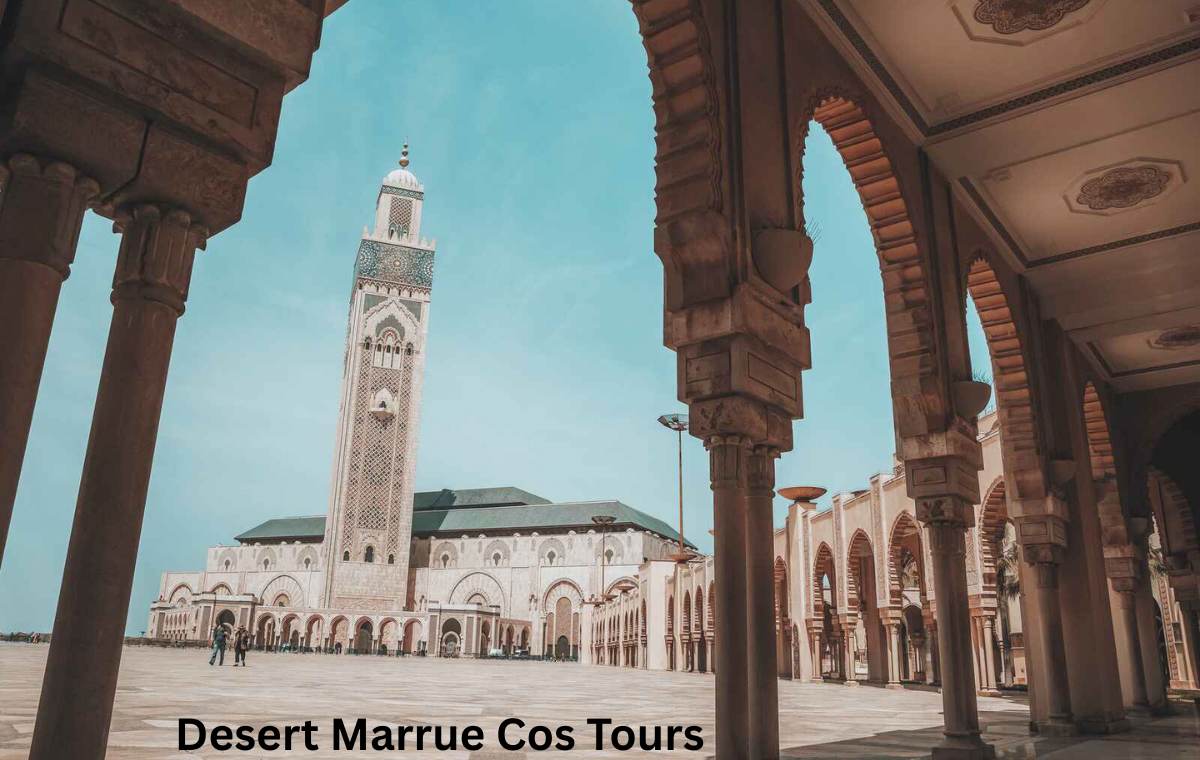
The trip opens at the Hassan II Mosque, one of only two mosques in Morocco open to non-Muslims. Official admission is 140 dirhams for foreign adults, with guided tours running roughly hourly through the day; the mosque’s minaret, ocean-facing platform, and zellige tilework are its defining features.
The afternoon transfer to Rabat covers the Hassan Tower, an unfinished 12th-century Almohad minaret, and the adjacent Mausoleum of Mohammed V. Travelers with extra time can walk the Oudaya Kasbah, Rabat’s own blue-and-white quarter above the Bou Regreg river, or the nearby Chellah necropolis.
Day 2 – Rabat to Chefchaouen
The drive north crosses the Rif Mountains into Chefchaouen, Morocco’s Blue City. The blue-washed alleys around Plaza Uta el-Hammam and the red-walled Chefchaouen Kasbah are the core of the visit; a short walk to the Spanish Mosque viewpoint above town is the standard way to close the day.
Day 3 – Chefchaouen to Fes
The drive south stops first at Volubilis, Morocco’s best-preserved Roman ruin, with a modest entrance fee and roughly an hour needed to see the Arch of Caracalla and the site’s floor mosaics. Meknes, one of the four imperial cities, follows – the monumental Bab Mansour gate, Lahdim Square, and the exterior of the Mausoleum of Moulay Ismail are the standard stops before the short drive on to Fes.
Day 4 – Fes
A full guided day in Fes el-Bali, the world’s largest car-free urban zone, entered through Bab Bou Jeloud, the ornate blue gate. Stops typically include the Chouara Tannery, the Al-Attarine Madrasa, the Bou Inania Madrasa, and the exterior of the Al-Qarawiyyin mosque and university – founded in 859 AD and recognized as the oldest continuously operating university in the world.
The afternoon usually covers the Mellah (Jewish quarter) in Fes el-Jedid and the trade-organized souks: metalwork, spices, leather, and ceramics each occupy their own section of the medina.
Days 5–6 – Fes to the Sahara
Day 5 crosses the Middle Atlas Mountains through Ifrane, nicknamed the “Switzerland of Morocco” for its alpine-style architecture, and the Azrou cedar forest, home to wild Barbary macaques. The route then descends through the Ziz Valley – a ribbon of date palms with a well-known viewpoint at the Tunnel du Légionnaire – passing Errachidia and Erfoud before reaching Merzouga at the edge of Erg Chebbi.
Day 6 is built around the desert: a visit to Khamlia village for a Gnawa music performance, an optional 4×4 excursion to meet Berber (Amazigh) nomad families, and a sunset camel trek into the dunes, followed by dinner and stargazing at a desert camp.
Day 7 – Merzouga to Dades Valley
After a desert sunrise, the route follows part of the Road of a Thousand Kasbahs, stopping at Rissani‘s traditional souk before reaching Todra Gorge – a limestone canyon narrowing to about 10 meters wide with walls up to 300 meters high. The Dades Valley and its “Monkey Fingers” rock formations follow for the night.
Day 8 – Dades Valley to Marrakech
The longest scenic day starts through the Rose Valley around Kelaa M’gouna and the palm groves of Skoura, then Ouarzazate, nicknamed the “Hollywood of Morocco” for the Atlas Film Studios and Kasbah Taourirt on its edge.
The main stop is Ait Benhaddou, a UNESCO-listed ksar built from packed earth and used as a filming location for productions including Gladiator, Game of Thrones, and Lawrence of Arabia. The day ends by crossing the Tizi n’Tichka Pass, at over 2,200 meters the highest paved mountain pass in the High Atlas Mountains, into Marrakech.
Days 9–10 – Marrakech and departure
A guided day covers the Bahia Palace (roughly 70–100 dirhams entry, prices have risen recently), the Saadian Tombs, the Marrakech medina souks, and Jardin Majorelle – the garden created by French painter Jacques Majorelle and later owned by Yves Saint Laurent – where a garden-only ticket runs about 170 dirhams for foreign visitors. The 12th-century Koutoubia Mosque minaret and the Ben Youssef Madrasa are common add-ons if time allows.
Day 10 leaves room for last-minute shopping – argan oil, leather, textiles – before transfer to Marrakech Menara Airport. Travelers with extra time before their flight can add stops from our Marrakech day trips page.
Food and Culture Along the Route
Meals on this route lean on a small set of Moroccan staples repeated with regional variation: tagine, couscous, and mint tea. Expect tagine (slow-cooked stew) most evenings, couscous traditionally on Fridays, pastilla as a Fes specialty, and sweet mint tea poured tableside at nearly every stop. The Berber (Amazigh) communities along the Atlas and Sahara legs make up most of the rural population you’ll meet outside the cities, distinct from the Arab-majority imperial cities – both traditions show up in the architecture, music, and craft souks along the way.
What’s Included and What’s Not
A private 10-day Casablanca to Marrakech trip typically includes transport, guiding, and most accommodation, but excludes international flights, most lunches, and entrance fees. Confirm the exact list before booking, since it varies by operator.
Usually included:
- Private, air-conditioned vehicle for the full route
- English-speaking driver-guide for all 10 days
- Airport pickup in Casablanca and drop-off in Marrakech
- 9 nights in riads, hotels, and one desert camp night
- Daily breakfast (some tours add dinner on desert nights)
- Camel trek and desert camp in Erg Chebbi
- Licensed local guides in Fes and Marrakech medinas
Usually excluded:
- International flights
- Lunches and most drinks
- Entrance fees to monuments (budget roughly $40–60 total across the mosque, palaces, and gardens on the route)
- Tips for driver and guides
- Travel insurance
How Much Does a 10-Day Casablanca to Marrakech Trip Cost?
A private 10-day Casablanca to Marrakech trip generally costs $900–$1,300 per person for a standard package, $1,300–$2,200 for a comfort-tier private tour, and $2,800–$4,500+ for a luxury version, excluding international flights. Price scales with accommodation tier, vehicle type, and group size – couples typically pay less per person than solo travelers, and groups of four or more pay less again.
| Tier | Per-Person Range | Accommodation | Vehicle |
|---|---|---|---|
| Budget / small group | $900–$1,300 | Standard hotels, guesthouses | Shared minivan |
| Mid-range private | $1,300–$2,200 | 3–4★ riads, standard desert camp | Private SUV |
| Luxury private | $2,800–$4,500+ | 5★ riads, luxury desert camp | Private 4×4, dedicated guide |
A solo traveler usually pays a single supplement, since the vehicle and driver cost is split across fewer people. Ask any operator to itemize the daily rate before comparing quotes – a “10-day Morocco tour” listed at half these prices is usually missing meals, guides, or the desert camp night.
Private Tour vs Small Group vs Self-Drive
A private tour is the standard choice for this route: one vehicle, one driver, and a schedule built around your group. The two alternatives – small group tours and self-driving – trade cost or flexibility for something else.
- Private tour. Custom pace, pickup at your hotel each morning, and a driver who handles the Tizi n’Tichka Pass and desert tracks. Best for couples, families, and travelers who don’t want to navigate mountain roads themselves. This is how the 10-day Casablanca to Marrakech trip runs by default with most operators, including ours.
- Small group tour. Joins 4–12 travelers on a fixed departure date and route. Lower cost per person, less control over timing.
- Self-drive. Rent a car in Casablanca, drop it in Marrakech. Workable for confident drivers, but Fes el-Bali and the Marrakech medina are car-free, and the Fes–Merzouga and Dades–Marrakech legs cross mountain passes that are demanding on a first visit. For alternate lengths of this same private-tour format, see our 8-day Casablanca desert tour or the 12-day Casablanca to Marrakech itinerary.
Best Time to Visit for This Route
Spring (March–May) and autumn (September–November) are the best windows for this trip, with mild city temperatures and comfortable desert conditions. Summer pushes Merzouga past 40°C, which limits the camel trek to early morning or sunset only. Winter is fine for the cities but can bring near-freezing nights in the desert and occasional snow on the Tizi n’Tichka Pass. Traveling during Ramadan is possible on this route, but expect reduced daytime restaurant hours and busier medinas after sunset – confirm the dates against your travel window before booking.
Practical Notes Before You Book
Citizens of the US, UK, EU, Canada, and Australia can enter Morocco visa-free for up to 90 days, with a passport valid at least six months beyond entry. The currency is the Moroccan dirham (MAD), which isn’t traded outside the country, so exchange or withdraw after arrival – ATMs are common in cities but scarce along the Merzouga–Dades stretch.
Tipping is customary and not included in tour prices: a common guideline is 100–200 MAD per day for a driver and 100–150 MAD per group for a half-day local guide. For a full breakdown of visa rules, packing, and money matters, our 10-day Morocco itinerary from Casablanca guide covers each in more depth.
Why Book This Trip With Desert Marruecos Tours?
Desert Marruecos Tours runs this route as a private, locally driven trip – one vehicle and driver for the full 10 days, not a shared coach seat. Pricing is quoted per group before booking, so the total cost of accommodation, transport, and guiding is clear upfront rather than assembled from add-ons. Drivers are based in Morocco and route around seasonal closures – such as snow on the Tizi n’Tichka Pass – rather than following a fixed script regardless of conditions. Our about us page has more on how our team and drivers work.
Frequently Asked Questions – 10-Day Casablanca to Marrakech Trip
Is 10 days enough for a Casablanca to Marrakech trip?
Yes. Ten days covers all four imperial cities, the Sahara, and Marrakech without cutting a major region. Trips under a week usually skip either Chefchaouen or the desert.
Can I customize the 10-day Casablanca to Marrakech trip?
Yes. Common changes include adding a night in Chefchaouen, extending the desert stay to two nights, or adding a day trip from Fes. Coastal add-ons like Essaouira usually add 1–2 days to the route rather than replacing a stop.
Do I need a 4×4 for the Sahara section?
Yes, for the final stretch into the dunes near Erg Chebbi. A standard sedan can’t handle the sand tracks; tour vehicles switch to 4×4 or transfer guests by camel for the last approach to camp.
Is this trip suitable for solo travelers?
Yes, though solo travelers usually pay a single supplement, since the vehicle and driver cost is shared across fewer people. Joining a small group tour reduces this cost if budget matters more than a private schedule.
How much walking is involved?
Each guided city section – Fes el-Bali, Marrakech’s medina, Todra Gorge – involves 2–4 hours of walking on uneven ground, including cobblestones and sand. Comfortable closed-toe shoes are recommended throughout.
How many UNESCO World Heritage Sites does this trip include?
Four: the medina of Fez, the medina of Marrakesh, the Roman ruins of Volubilis, and the ksar of Ait Benhaddou. All four sit directly on this route without requiring a detour.
What’s the difference between this trip and a Casablanca-to-Casablanca itinerary?
This trip ends in Marrakech, with departure from Marrakech Menara Airport, so there’s no return drive. Travelers flying out of Casablanca instead can add a final transfer – see our 10-day Morocco itinerary from Casablanca for the loop version that returns to Casablanca.
How many nights are spent in the desert?
One night is standard on the 10-day version, in a desert camp at Erg Chebbi. Travelers who want a second night can add it on the 12-day Casablanca to Marrakech itinerary without changing the rest of the route.
Are meals during the trip halal and vegetarian-friendly?
Yes. Moroccan cuisine is halal by default, and vegetarian versions of tagine and couscous are standard at riads and desert camps – flag dietary restrictions when booking so camp kitchens can plan ahead.
Book Your 10-Day Casablanca to Marrakech Trip
This route runs as a private trip with fixed inclusions, or as a customized version with extra nights in Chefchaouen, the desert, or Marrakech. Contact us with your travel dates and group size for a per-person quote, or start from our homepage to compare other Morocco tour lengths.