
A complete 12-day Morocco itinerary covers the imperial cities (Casablanca, Rabat, Meknes, Fes), a crossing of the Middle Atlas and High Atlas Mountains, a night in the Sahara Desert at Merzouga or Zagora, and a finish in Marrakech or back along the Atlantic coast. Twelve days is long enough to see the imperial cities, the desert, and the Atlas passes without rushing – a balance shorter trips (5–7 days) and longer trips (14+ days) don’t offer.
Twelve days is one of the most searched Morocco itinerary lengths because it is the shortest trip that comfortably fits both the imperial cities and a real Sahara Desert experience, including at least one overnight in a desert camp. This guide lays out the full day-by-day route, explains why the stops are ordered the way they are, and covers the practical planning details – drive times, overnight towns, and pacing – that most itinerary pages skip.
What Does a 12-Day Morocco Itinerary Typically Include?
A standard 12-day Morocco itinerary typically includes four to five imperial cities, one Atlas Mountains crossing, one or two nights in the Sahara Desert, and a final stretch in Marrakech or along the Atlantic coast at Essaouira. Most routes start in Casablanca (the main international gateway) and end in Marrakech, or run the reverse.
The most common structure looks like this:
- Days 1–3: Casablanca, Rabat, Meknes, Volubilis, Fes
- Days 4–6: Middle Atlas, Ziz Valley, Merzouga and the Sahara
- Days 7–9: Todra Gorge, Dades Valley, Ouarzazate, Ait Benhaddou
- Days 10–12: Marrakech, with an optional Essaouira or Atlas Mountains day trip
This structure works because each leg builds naturally on the last: history and architecture in the north, desert landscape in the middle, and souks and mountains at the close. Our own 12-day tour from Fes to Marrakech and 12-day Casablanca to Marrakech route both follow this logic, adjusted for the starting airport.
Day-by-Day 12-Day Morocco Itinerary
Day 1–2: Casablanca and Rabat
Most travelers land at Mohammed V Airport in Casablanca. The city itself only needs half a day – the Hassan II Mosque, one of the largest mosques in the world, is the main stop worth the time. From there, the route moves to Rabat, Morocco’s capital, for the Kasbah of the Udayas, the Hassan Tower, and the Mausoleum of Mohammed V.
Why this order: Casablanca is functional (arrival city, one major landmark), while Rabat is calmer and better suited to a full day of sightseeing before the longer drive east.
Day 3: Meknes, Volubilis, and Fes
The drive from Rabat continues to Meknes, an imperial city built by Sultan Moulay Ismail, known for the Bab Mansour gate and the royal stables. Just outside the city sit the Volubilis Roman ruins, one of the best-preserved Roman sites in North Africa. The day ends in Fes, home to the Fes el Bali medina (a UNESCO World Heritage Site) and the Al-Qarawiyyin University, often cited as one of the oldest universities in the world.
Day 4: Fes to the Sahara Gateway
This is the longest driving day. The route crosses the Middle Atlas Mountains through Ifrane, sometimes called “Little Switzerland” for its European-style architecture and cedar forests, then continues through Azrou (known for its Barbary macaque population), Midelt, and down through the Ziz Valley – a dramatic palm-lined gorge – toward Merzouga, gateway to the Erg Chebbi dunes.
Day 5: Erg Chebbi Desert Camp
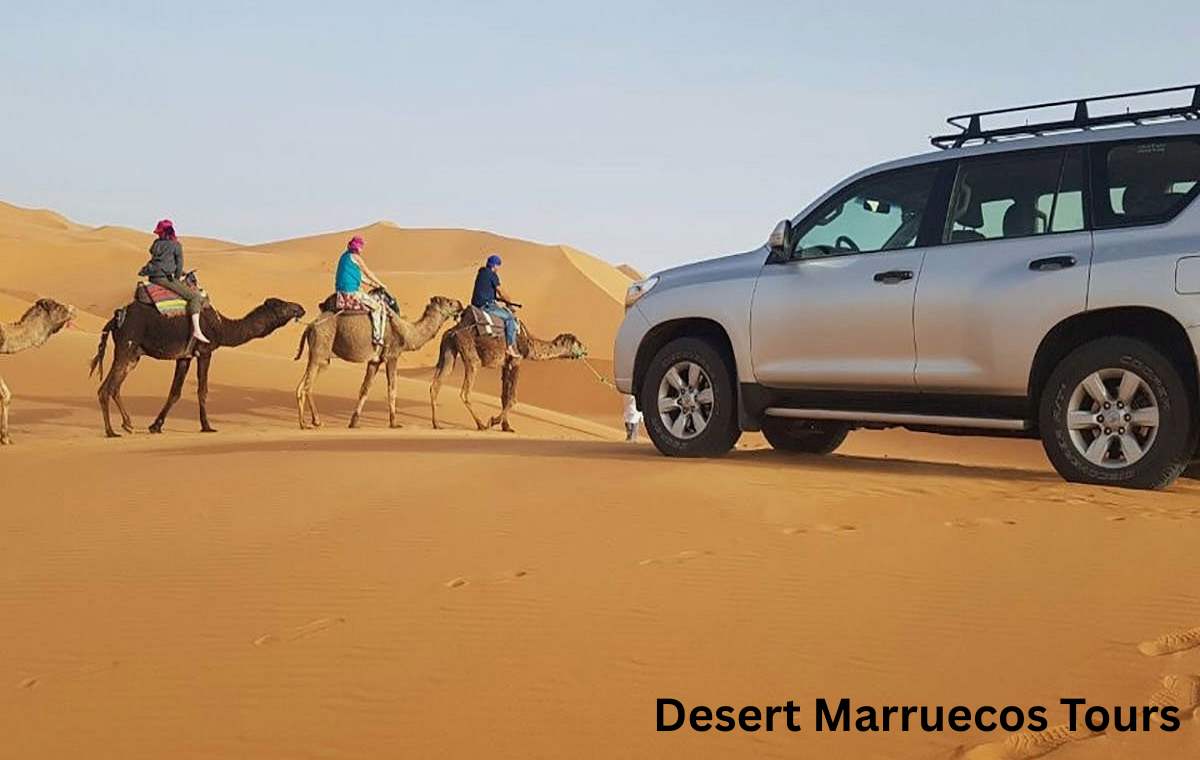
This is the desert highlight. Travelers typically switch to 4×4 vehicles or camels for the final stretch into the dunes, arriving at a desert camp in time for sunset. A camel trek, dinner under the stars, and traditional Gnawa music around the fire are standard inclusions. Camps range from basic shared tents to private luxury tents with en-suite bathrooms – see our luxury desert camp cost guide for pricing by tier.
Day 6–7: Todra Gorge, Dades Valley, Ouarzazate
Leaving Merzouga, the route passes through Rissani and Erfoud before reaching the Todra Gorge, a narrow canyon with rock walls rising over 300 meters, and the Dades Valley, known locally as the “Valley of Roses.” The road continues along the Road of a Thousand Kasbahs to Ouarzazate, often called the “Hollywood of Morocco” for its film studios.
Day 8: Ait Benhaddou and the Tizi n’Tichka Pass
Ait Benhaddou, a fortified UNESCO-listed ksar (fortified village) used as a filming location for productions including Gladiator and Game of Thrones, is a short drive from Ouarzazate. From there, the route climbs the Tizi n’Tichka Pass through the High Atlas Mountains toward Marrakech.
Day 9–11: Marrakech
Marrakech needs at least two full days. Highlights include Jemaa el-Fnaa square, the Bahia Palace, the Saadian Tombs, the Koutoubia Mosque, and the Jardin Majorelle. The medina souks are best explored with a half-day guided walk to avoid getting lost and to negotiate fair prices. Travelers with an extra day often add a trip to Essaouira on the coast or a High Atlas village visit near Imlil.
Day 12: Departure
The final day is typically a transfer back to Marrakech Menara Airport, or an early flight from Casablanca if the route runs in reverse.
12-Day Morocco Itinerary at a Glance
| Days | Region | Key Stops |
| 1–2 | Atlantic Coast | Casablanca, Rabat |
| 3 | Imperial Cities | Meknes, Volubilis, Fes |
| 4–5 | Sahara Desert | Middle Atlas, Ziz Valley, Merzouga, Erg Chebbi |
| 6–8 | Valleys & Kasbahs | Todra Gorge, Dades Valley, Ouarzazate, Ait Benhaddou |
| 9–11 | Marrakech | Medina, Atlas foothills, optional Essaouira |
| 12 | Departure | Marrakech or Casablanca |
Is 12 Days Enough for Morocco?
Yes, 12 days is enough to cover the imperial cities, one Atlas crossing, and one desert overnight without rushing. It is the minimum length most operators recommend for combining Fes, the Sahara, and Marrakech in a single trip, since shorter trips (7–8 days) typically force travelers to choose between the desert and the northern imperial cities.
If your schedule is tighter, see how the route compresses in our 10-day Morocco itinerary and 10-day itinerary from Casablanca. If you have more time, our 15-day Morocco exploration tour adds Chefchaouen and the Atlantic coast.
Private Tour vs. Self-Drive for a 12-Day Route
| Factor | Private Guided Tour | Self-Drive |
| Local knowledge | Driver/guide explains sites, history, culture | Self-researched |
| Desert access | Included 4×4 transfer to camp | Requires arranging separately |
| Mountain driving | Handled by experienced local driver | Tizi n’Tichka has sharp switchbacks |
| Flexibility | Fixed route, adjustable with advance notice | Fully flexible |
| Cost | Higher per day, all-inclusive | Lower base cost, extra planning time |
Most first-time visitors choose a private guided route because the Tizi n’Tichka Pass and desert-track driving are demanding for unfamiliar drivers, and a private driver removes the logistics of arranging separate desert transfers and camp bookings.
Best Time of Year for a 12-Day Route
Spring (March–May) and fall (September–November) are the best months, since the Sahara Desert stretch is far more comfortable outside peak summer heat, and mountain passes are clear of the winter’s occasional snow. Full seasonal detail is in our best time to visit Morocco guide.
FAQ: 12-Day Morocco Itinerary
Does a 12-day Morocco itinerary include the desert?
Yes. Every well-built 12-day route includes at least one night in the Sahara Desert, usually at Merzouga (Erg Chebbi dunes) or occasionally Zagora.
Which imperial cities are included in 12 days?
A complete route covers Rabat, Meknes, and Fes, with Casablanca as the arrival point and Marrakech as the closing city.
Can I start a 12-day itinerary from Marrakech instead of Casablanca?
Yes. The route simply runs in reverse – Marrakech, Ait Benhaddou, Ouarzazate, the desert, Fes, Meknes, Rabat, Casablanca.
Is Chefchaouen included in a standard 12-day route?
Not usually. Chefchaouen sits further north and typically requires 14+ days to include without cutting time elsewhere.
How much driving is involved in 12 days?
Expect two to three long driving days (4–7 hours), notably Fes to Merzouga and Merzouga to Ouarzazate, balanced by shorter transfer days elsewhere.
Do I need a private guide for 12 days, or can I do it independently?
Both are possible. A private tour is recommended for the desert and mountain legs specifically, since road conditions and logistics (camel transfers, camp bookings) are easier to manage with a local operator.
What’s the difference between a 12-day itinerary and a 12-day imperial cities and desert tour?
A general 12-day itinerary is route-flexible and can be self-planned; a 12-day imperial cities and desert tour is typically a structured, bookable package with fixed inclusions.
Is 12 days too long for Morocco?
No. Twelve days matches the country’s main highlights well; it becomes “too long” only if you plan to stay in just one or two cities.
Plan Your 12-Day Morocco Itinerary
A well-built 12-day route balances history, desert, and mountains without over-packing any single day. If you’d like this itinerary customized to your travel dates, group size, and desert camp preference, contact us to build a tailored plan, or browse more route options on our Morocco travel blog and homepage.