
A 15-day Morocco itinerary follows the same loop as the 14-day version – Casablanca, Chefchaouen, Fes, Merzouga (Sahara Desert), the Dades Valley, Aït Benhaddou, Marrakech, and Essaouira – with one extra day added where travelers most often want it: Fes, the desert, or Marrakech. The extra day reduces daily driving pressure and adds depth rather than adding a new destination.
Why the Extra Day Changes Everything
The difference between a 14-day and a 15-day Morocco itinerary is not a new city. It is breathing room.
On a 14-day loop, every stop is comfortable but tight. Fes gets two full days, which covers the highlights but leaves the cooking class, the Mellah, and the quieter afternoon souks for a different trip. The desert gets one night, which is enough for a camel trek and a dune sunrise but not enough for a 4×4 excursion or a nomad village visit. Marrakech gets two days, which covers the main palaces and the souks but leaves Ouzoud Waterfalls and Agafay Desert as things you looked at in a guide and did not have time for.
The extra day on a 15-day itinerary goes directly into whichever of those gaps matters most to you. For most travelers, it lands in Fes, the desert, or Marrakech. The route stays identical. The pace simply relaxes.
15-Day Morocco Itinerary at a Glance
| Day | Stop | Highlights |
| 1 | Casablanca | Hassan II Mosque, Corniche, Habous Quarter |
| 2 | Rabat → Chefchaouen | Hassan Tower, Kasbah of the Udayas, Blue City arrival |
| 3 | Chefchaouen | Blue medina, Spanish Mosque viewpoint, Akchour option |
| 4 | Volubilis → Meknes → Fes | Roman ruins, Bab Mansour gate, imperial stables |
| 5–7 | Fes | Tanneries, Al-Qarawiyyin, medina souks, cooking class, Mellah |
| 8 | Fes → Merzouga | Ifrane, Azrou cedar forest, Ziz Valley, Sahara arrival |
| 9 | Merzouga / Erg Chebbi | Camel trek, desert camp, dune sunrise |
| 10 | Todra Gorge → Dades Valley | Canyon walk, Monkey Fingers, Vallée des Roses |
| 11 | Dades → Ouarzazate → Aït Benhaddou → Marrakech | UNESCO ksar, film studios, Tizi n’Tichka |
| 12–13 | Marrakech | Jemaa el-Fnaa, Bahia Palace, Jardin Majorelle, hammam, souks |
| 14 | Essaouira | Ramparts, fishing port, Gnawa music, free afternoon |
| 15 | Essaouira → Casablanca | Coastal drive, El Jadida optional, departure |
The Full Day-by-Day Route
Day 1 – Casablanca
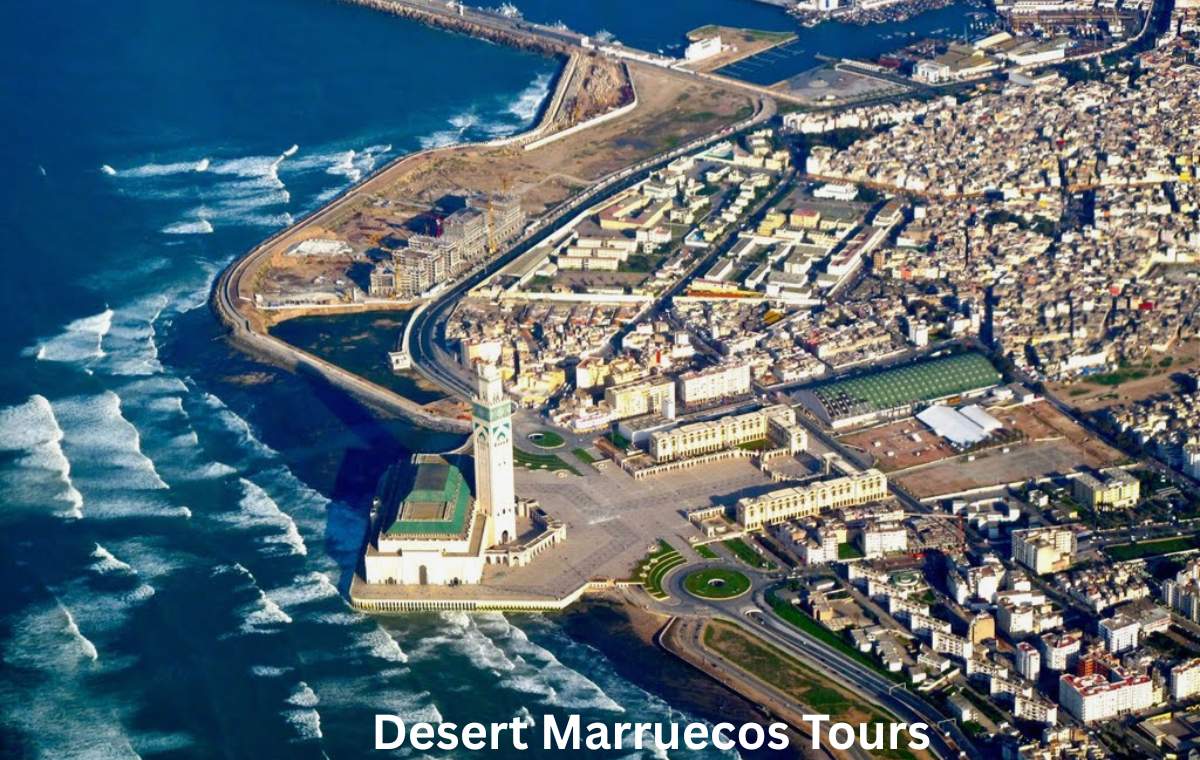
Arrive at Mohammed V International Airport. Pick up a Maroc Telecom SIM card at arrivals – it has the best rural coverage for the desert legs ahead. Spend the afternoon at the Hassan II Mosque, one of the world’s largest, built partly over the Atlantic Ocean with a retractable roof and an open-air ablution hall. Walk the Corniche seafront and eat dinner in the Habous Quarter, a French-colonial-era arcade neighborhood with the best pastry shops in Casablanca.
Day 2 – Rabat and the Drive to Chefchaouen
Drive one hour north to Rabat. See the Hassan Tower, the unfinished 12th-century minaret standing beside the Mausoleum of Mohammed V, and walk through the Kasbah of the Udayas above the Bou Regreg estuary. If time allows, stop at the Chellah Necropolis – a walled ruin of Roman and Marinid remains filled with nesting storks and wild cats. Drive 3.5 hours north to Chefchaouen and arrive by late afternoon.
Day 3 – Chefchaouen
Walk Rue Targhi and Rue Lalla el Hora before 8 am, when the blue lanes are empty and the light is at its best. Visit Uta el-Hammam Square and the ruined Portuguese-era fort beside the mosque. Climb the 20-minute path to the Spanish Mosque above the town for the panoramic view of blue rooftops against the green Rif Mountains. Walk to the Ras el-Maa waterfall at the medina’s eastern edge in the afternoon.
For active travelers: the Akchour Waterfalls hike (25 km from Chefchaouen, 3 hours round trip) through a forested gorge is one of the best half-day walks in northern Morocco and is rarely crowded.
Day 4 – Volubilis, Meknes, and Fes
Stop at Volubilis, Morocco’s best-preserved Roman site and a UNESCO World Heritage listing. The ruins include triumphal arches, mosaic floors, and ancient olive presses dating to the 1st–3rd centuries AD. Allow 90 minutes. Continue 30 minutes to Meknes: see the enormous Bab Mansour gate, walk Place el-Hedim, visit the Moulay Ismail Mausoleum, and see the Heri es-Souani royal stables built for 12,000 horses. Drive one hour east to Fes and check into a riad inside the medina walls.
Days 5–7 – Fes: Three Full Days in the Medieval City
Three days in Fes is the version most travelers wish they had booked. Here is how those days divide naturally.
Day 5 – The Classic Medina Circuit
Hire a licensed local guide from the official tourism office – the only reliable way to navigate Fes el-Bali’s 9,000 lanes. Start at Bab Bou Jeloud (the Blue Gate) and walk Talaa Kebira to the Chouara Tannery (buy a mint sprig from the leather shops above). Continue to Al-Qarawiyyin University, founded in 859 AD, and the Bou Inania Madrasa with its carved cedarwood, stucco carvings, and zellige tile. Finish at the Nejjarine Fountain and the Museum of Wooden Arts.
Day 6 – The Mellah, Souks, and Cooking Class
Spend the morning in the named souks of Fes el-Bali – Souk El Attarine (spices and perfumes), the leather souk, the carpet souk, and Souk Haddadine (blacksmiths). Walk through the Mellah, the old Jewish Quarter, where Star of David carvings and Hebrew inscriptions remain on doors. Book a Moroccan cooking class inside a traditional riad for the afternoon: three to four hours teaching tajine, bastilla, harira, and mint tea, ending with lunch.
Day 7 – Slow Morning and Departure for the Sahara
Wake early and leave Fes by 7 am for the long drive south. The third Fes day means Day 5 and 6 were not rushed, and today’s departure feels calm rather than crammed. Stop at Ifrane (the alpine Swiss-style town), the Azrou cedar forest (Barbary macaques along the roadside), and Midelt for lunch. Descend through the spectacular Ziz Valley oasis gorge and arrive in Merzouga by late afternoon.
Day 8 – Merzouga and Erg Chebbi: The Sahara Desert
Wake before dawn for the dune sunrise. After breakfast, take a 4×4 excursion into the deeper desert to Khamlia village, where descendants of sub-Saharan African communities maintain the Gnawa music tradition – a hypnotic spiritual practice with iron castanets and bass lutes. Most trips include a short live session inside a family home.
Spend the hottest midday hours at the camp or guesthouse. In the late afternoon, mount a camel for the sunset trek (1.5–2 hours) into Erg Chebbi and arrive at your desert camp for the night. Dinner by firelight, Berber drumming, and some of the darkest skies in North Africa.
Desert Camp Tiers – Know What You Are Paying For:
| Camp Type | Cost per Night | What Is Included |
| Budget tent | $25–50 | Shared tent, basic dinner, communal bathrooms |
| Standard camp | $80–150 | Private tent, dinner, live music, shared bathroom |
| Luxury camp | $200–500+ | Ensuite tent, gourmet dinner, private terrace, hot shower |
Day 9 – Todra Gorge and Dades Valley
Drive west through Erfoud (fossil shops, trilobites, and ammonite carvings) to Todra Gorge, where 300-meter vertical canyon walls narrow to a 10-meter-wide corridor with a cold river running through the base. Walk the gorge floor – flat, easy, 30 minutes each way – and eat lunch at a riverside café where trout from the stream is the specialty.
Continue to the Dades Gorge and the Monkey Fingers rock formations. If traveling in late April or May, the route passes through the Vallée des Roses near El Kelâa M’Gouna – fields of Damask roses harvested for rosewater sold at roadside cooperatives. Drive through Skoura palm oasis to Ouarzazate or Boumalne Dades for the night.
Day 10 – Aït Benhaddou and the Atlas Crossing to Marrakech
Visit Aït Benhaddou, the UNESCO mud-brick ksar used as a film location for Gladiator, Game of Thrones, and The Mummy. Cross the river on stepping stones, climb through the narrow lanes to the top, and photograph the golden mud walls against the Anti-Atlas mountains. Stop briefly at Atlas Studios in Ouarzazate if time allows.
Drive the Tizi n’Tichka pass (2,260 meters, the highest paved road in Morocco) through tight switchbacks and sudden temperature drops, past Berber villages selling argan oil, amethyst, and fossils. Arrive in Marrakech by early evening.
Days 11–12 – Marrakech: Two Full Days
Day 11: Visit Jemaa el-Fnaa early morning, then the Koutoubia Mosque, Bahia Palace, Saadian Tombs, El Badi Palace ruins, and Ben Youssef Madrasa. Return to Jemaa el-Fnaa in the evening for the full food-market transformation.
Day 12: Start at Jardin Majorelle and the Berber Museum. Spend midday in the named souks – Souk Semmarine, Souk El Attarine, Souk Cherratine, Souk des Babouches, Souk Haddadine. Book a traditional hammam session in the afternoon. Choose a half-day excursion if energy allows: Ouzoud Waterfalls (2.5 hours, 110-meter cascade with wild macaques in the trees) or Agafay Desert (1 hour, rocky moonscape without sand).
Day 13 – Marrakech to Essaouira
Drive 2.5 hours west to Essaouira. Walk the Skala de la Ville sea ramparts with their bronze Atlantic-facing cannons. Visit the fishing harbor – blue boats, charcoal grills, and the morning catch served by noon. The medina is calmer than Marrakech: white and blue walls, thuya wood craftsmen, and the persistent sound of wind and seagulls. Buy thuya wood, argan oil, or hand-painted blue pottery. Eat fresh sardines at the port stalls or dinner at Chez Sam, the harborside fish restaurant with decades of history.
Day 14 – Free Day in Essaouira
This is one of the most valuable days on the entire 15-day itinerary – and one of the most underrated.
Essaouira rewards a slow day. Walk the Mellah (the old Jewish Quarter with its distinctive architecture) and explore the Souk Jdid and the spice market at your own pace without a schedule. Visit Diabat village, 5 km south, where Jimi Hendrix stayed in 1969 and where a crumbling kasbah sits at the beach edge.
The free day in Essaouira is what the 15-day itinerary is really for. It is the version of Morocco travel where you stop passing through and start actually being somewhere.
Day 15 – Coastal Drive Back to Casablanca
Drive north along the Atlantic coast. Stop at El Jadida – a coastal town with a remarkable Portuguese Cistern, a vaulted stone chamber with a thin layer of water on the floor that reflects the columns above it in perfect symmetry. It is a UNESCO World Heritage site and one of Morocco’s most atmospheric stops, almost entirely absent from standard grand tour itineraries. Continue through Azemmour, a quiet whitewashed riverside town on the Oum Er-Rbia, and arrive at Casablanca Mohammed V Airport for departure.
Where to Add the Extra Day: The Three Best Options
Option 1: A Third Night in Fes
Fes is the stop that most travelers leave wishing they had stayed longer. The medina has 9,000 lanes. Two days covers the main circuit. Three days covers the main circuit plus the named souks, the Mellah, the cooking class, and a slow morning at Jnan Sbil Gardens without rushing to pack for the desert. If you are visiting Morocco specifically for its Islamic architecture, culture, and history, put the extra day here.
Option 2: A Second Night in Merzouga
One night in the desert covers a camel trek and a dune sunrise. Two nights covers all of that plus a 4×4 excursion, a visit to Khamlia village for Gnawa music, a sandboarding session on the dunes, and an optional visit to a nomadic Berber family living outside the tourist camp circuit. If the Sahara is the reason you booked the trip, put the extra day here.
Option 3: A Third Day in Marrakech
Two days in Marrakech covers the medina highlights and the souks. Three days adds either Ouzoud Waterfalls (a 2.5-hour drive to a spectacular 110-meter cascade with wild Barbary macaques in the surrounding trees) or the Agafay Desert (1 hour from the city, a rocky lunar landscape popular for sunset dinners and hot air balloon flights). If Marrakech is your base and you want day-trip options without cutting into palace and souk time, put the extra day here.
Transport and Driving Times
A private driver-guide is the most practical option for a 15-day loop. Trains serve Casablanca, Rabat, Fes, and Marrakech but do not reach Merzouga, Todra Gorge, Aït Benhaddou, or Essaouira.
| Leg | Distance | Driving Time |
| Casablanca → Rabat | 90 km | 1 hour |
| Rabat → Chefchaouen | 250 km | 3.5–4 hours |
| Chefchaouen → Fes (via Volubilis, Meknes) | 290 km | 4–5 hours with stops |
| Fes → Merzouga | 460 km | 6–7 hours |
| Merzouga → Todra Gorge | 160 km | 2.5 hours |
| Todra Gorge → Boumalne Dades | 55 km | 1 hour |
| Boumalne Dades → Aït Benhaddou | 150 km | 2.5 hours |
| Aït Benhaddou → Marrakech (Tizi n’Tichka) | 185 km | 3 hours |
| Marrakech → Essaouira | 175 km | 2.5 hours |
| Essaouira → Casablanca (via El Jadida) | 350 km | 3.5–4 hours |
Budget for a 15-Day Morocco Itinerary
| Tier | 14-Day Total | 15-Day Total | Extra Day Cost |
| Budget | $770–1,330 | $825–1,425 | ~$55–95 |
| Mid-range | $2,660–4,340 | $2,850–4,650 | ~$190–310 |
| Luxury | $6,440–15,400+ | $6,900–16,500+ | ~$460–1,100+ |
The extra day adds one night of accommodation, one day of meals, and one day of private driver cost. On a mid-range budget, that is roughly $190–310 extra for a day that most travelers describe as the most relaxed and memorable of the entire trip.
What to Pre-Book on a 15-Day Morocco Itinerary
| Item | How Far in Advance |
| Luxury desert camp in Merzouga | 6–8 weeks (peak season) |
| Licensed Fes medina guide | 2–4 weeks |
| Riad in Chefchaouen medina | 3–4 weeks |
| Cooking class in Fes | 1–2 weeks |
| Hammam session in Marrakech | 1 week |
| Kitesurfing lesson in Essaouira | Book on arrival or 1 week ahead |
Best Time for a 15-Day Morocco Itinerary
| Season | Conditions | Best For |
| March–May | Comfortable everywhere, roses in bloom | First-time travelers, couples |
| June–August | Desert heat (45°C+), Essaouira pleasant and breezy | Coast-focused travelers |
| September–November | Second-best window, warm days, cool nights | All traveler types |
| December–February | Cold desert nights, possible Atlas pass snow | Budget travelers, photographers |
Book 6–8 weeks ahead for March–May and September–November. Desert camps and popular Fes riads fill up early in these windows.
Frequently Asked Questions
Is 15 days too long for Morocco?
No. Fifteen days adds one buffer day to the standard 14-day loop. Most travelers use it to slow down in Fes, the Sahara, or Marrakech rather than adding a new destination. Nearly every traveler who completes this itinerary says they wish they had stayed longer, not shorter.
Can I shorten this to 12–13 days?
Yes, by reducing Marrakech to one day, dropping Essaouira, or combining Volubilis and Meknes into a faster stop en route to Fes. Most travelers find the coastal finish worth keeping if time allows.
Is this itinerary family-friendly?
Yes, particularly with the extra day, which reduces back-to-back driving pressure and gives children more downtime between activities. The Azrou cedar forest, Atlas Studios in Ouarzazate, and the camel trek in Merzouga are consistent family highlights.
Can I start in Marrakech instead of Casablanca?
Yes. The loop works cleanly in either direction. Starting in Marrakech means reaching the Sahara Desert on Days 4–5 while energy is highest, finishing with the calm of Chefchaouen before flying home from Casablanca.
What is the biggest difference between 14 and 15 days in Morocco?
Pace. The 15-day version does not add a new city. It gives you one full day where you are not thinking about the next morning’s departure – one day in a medina, a desert, or a coastal town where the schedule disappears and the trip becomes an experience rather than an itinerary.